 Abdur Rouf
To rank in ChatGPT search, your pages must be open to OpenAI’s search crawler, OAI-SearchBot, findable through the search sources ChatGPT uses, and clear enough to answer the question someone asked. OpenAI says ranking uses multiple factors and placement is not guaranteed. So there is no switch to flip, only foundations to get right.
This guide sticks to what OpenAI has published: how ChatGPT search finds sources, which crawlers to allow, how to track the visits it sends, and what I would do with content and brand mentions. Where I am giving my opinion rather than OpenAI’s, I say so.
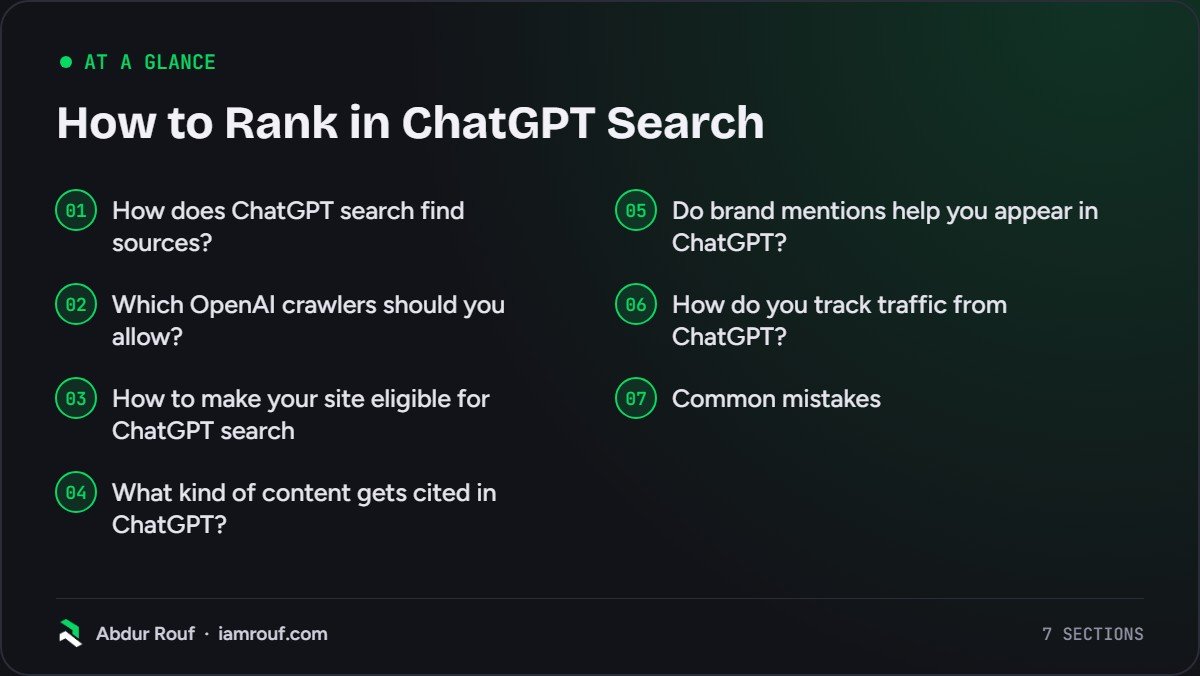
How does ChatGPT search find sources?
ChatGPT search decides when a question needs current information, rewrites it into one or more targeted search queries, and sends those to its search partners. It reviews the results, may run follow-up queries, and then writes an answer with citations. Your page has to be in the pool those searches return before it can be cited.
That description comes from OpenAI’s ChatGPT search help article. The same article says that, to be eligible, a site must allow OAI-SearchBot to crawl it, and its host or CDN must allow traffic from OpenAI’s published search bot IP addresses. It also states that ranking uses multiple factors and placement is not guaranteed.
When OpenAI launched ChatGPT search on 31 October 2024, it said the feature draws on third-party search providers plus content that partners provide directly. It listed news publishers such as Reuters, the Financial Times and Associated Press as partners, and said any website or publisher can choose to appear.
Does ChatGPT search use Bing?
OpenAI does not name its search providers on the pages I checked. Its search help article lists Microsoft’s privacy statement among the privacy references for its providers, which is why many SEOs assume Bing is one of them. That is a reasonable inference, not a documented fact.
My practical advice is the same either way: make sure Bing can crawl and index your important pages. It costs little, and Bing visibility is worth having on its own.
Which OpenAI crawlers should you allow?
Allow OAI-SearchBot if you want to appear in ChatGPT search. GPTBot is a separate crawler for model training, and you can block it without affecting search. ChatGPT-User visits pages when a user asks ChatGPT to, and it is not an automatic crawler. Each one is set separately in robots.txt.
Here is how OpenAI’s crawler documentation describes them:
| User agent | What it does | Effect of blocking it |
|---|---|---|
| OAI-SearchBot | Finds and surfaces websites in ChatGPT’s search features | Your pages will not appear in ChatGPT search answers, though they may still appear as navigational links |
| GPTBot | Crawls content that may be used to train OpenAI’s foundation models | Signals your content should not be used for training; search is controlled separately |
| ChatGPT-User | Visits a page when a user’s request in ChatGPT or a custom GPT needs it | OpenAI says robots.txt rules may not apply, because a user started the action |
The same page says that if you allow both GPTBot and OAI-SearchBot, OpenAI may use one crawl for both purposes. It also says search changes take about 24 hours to take effect after you update robots.txt.
A robots.txt that allows ChatGPT search but opts out of training looks like this:
User-agent: OAI-SearchBotAllow: /
User-agent: GPTBotDisallow: /
Whether to block GPTBot is a business decision about training, not an SEO one. Just do not block OAI-SearchBot by accident while making it.
How to make your site eligible for ChatGPT search
Work through these in order. The first three are technical and quick to check. The rest take longer.
- Check robots.txt. Look for a
User-agent: *group with broad Disallow rules, or a specific block on OAI-SearchBot. Either can keep you out. - Check your firewall and CDN. Bot protection can block OpenAI’s crawler even when robots.txt allows it. OpenAI publishes the IP ranges for OAI-SearchBot on its crawler page, so your host can allowlist them.
- Make sure key pages are indexable. Pages should return a 200 status, have no stray noindex tags and load their main text without needing scripts to run. My technical SEO checklist covers these checks.
- Use noindex for pages you want kept out. OpenAI’s publisher FAQ says a disallowed page can still appear as a bare link and title if its URL is known from elsewhere. A noindex meta tag prevents that, but the crawler must be allowed to fetch the page to see it.
- Give each important question a clear page. More on format below.
- Build your reputation off-site. Covered in the brand mentions section.
- Track referrals and review monthly. Covered in the tracking section.
What kind of content gets cited in ChatGPT?
OpenAI has not published a list of ranking factors for ChatGPT search, so anyone claiming to know them exactly is guessing. What follows is my professional opinion, based on how search-then-write systems work: the model needs a passage that answers the rewritten query clearly, from a page it has reason to trust.
In practice, that means:
- Answer first. Put the direct answer at the top of the page or section, then the detail.
- Be specific. Prices, service areas, opening hours, specifications, steps and limits give the model something concrete to quote.
- Use descriptive headings. A heading that matches the question makes the relevant passage easy to find.
- Use tables for comparisons. Plans, sizes, features and options are clearer in a table than in prose.
- Keep it current. Show when a page was updated and actually update it. Out-of-date prices or services get repeated back to customers.
- Show who is behind it. Author names, credentials, a real address and contact details help people judge you, and they give AI tools consistent facts about your business.
None of this is special to ChatGPT. It is good page writing, and my on-page SEO checklist covers the structural side. The generative engine optimisation guide explains how this fits across Google, ChatGPT and other AI tools.
Do brand mentions help you appear in ChatGPT?
Probably, though OpenAI has not said so directly. When someone asks ChatGPT for the “best” provider of something, the searches it runs often return review sites, comparison articles and directories. If your business is mentioned on those pages, it can be named in the answer even when your own site is not cited.
That is my reading of how the system works, not a documented ranking factor. The practical side is the same as good digital PR: earn reviews, get listed in the directories that matter in your industry, and pitch useful stories to publications your customers read. My guide to building high-quality backlinks covers several of these methods.
Avoid paying for placement in thin “top 10” lists. They are easy to spot, and if the list loses credibility, so does your mention.
How do you track traffic from ChatGPT?
Segment visits with the utm_source=chatgpt.com parameter in your analytics tool. OpenAI’s publishers and developers FAQ says ChatGPT adds it to referral links automatically for publishers that allow OAI-SearchBot. Pair that with a regular check of the questions you care about.
A simple tracking routine:
- Create a saved report or exploration in your analytics filtered to that source, with landing pages and conversions.
- Keep a list of 10 to 20 questions your customers really ask, and run them in ChatGPT search once a month. Record whether you are cited, which page, and what the answer says about you.
- Add “How did you hear about us?” to enquiry forms, and log answers that mention ChatGPT.
Answers vary between sessions, so judge the trend over several months, not a single check. If ChatGPT shows something wrong about your business, OpenAI’s launch post gives publishers-feedback@openai.com as the address for publisher feedback.
Common mistakes
- Blocking all AI bots with one rule, which removes you from ChatGPT search as well as training.
- Assuming robots.txt is the only gate, when a CDN or security plugin is quietly blocking the crawler.
- Rewriting pages into short fragments “for AI” and losing the depth that made them worth citing.
- Chasing a single prompt result instead of tracking a set of questions over time.
- Ignoring what other sites say about you, which is often what ChatGPT reads first for comparison questions.
FAQs
Can you pay to rank in ChatGPT search?
OpenAI’s search documentation describes no paid route into organic answers; its help article says ranking uses multiple factors and placement is not guaranteed. Advertising is separate. OpenAI’s crawler page mentions OAI-AdsBot, which checks landing pages submitted as ads on ChatGPT. Anyone selling guaranteed organic placement in ChatGPT answers is promising something OpenAI does not offer.
How long does it take to appear after allowing OAI-SearchBot?
OpenAI’s crawler documentation says search-related robots.txt changes take about 24 hours to take effect. That only covers access. Whether your pages are then cited depends on whether they are relevant to the questions people ask and how they compare with other sources. Nobody can honestly promise a date for that.
Will blocking GPTBot stop my site appearing in ChatGPT?
No. OpenAI treats GPTBot and OAI-SearchBot as independent settings. GPTBot relates to training data, and OAI-SearchBot controls whether your site appears in ChatGPT search answers. You can disallow GPTBot and allow OAI-SearchBot in the same robots.txt file, as in the example earlier in this guide.
Is ranking in ChatGPT different from ranking in Google?
The foundations are shared: a crawlable site, clear pages and a good reputation. The differences are the crawler you must allow, the search sources ChatGPT draws on, and how you measure it. Google publishes far more guidance about its AI features than OpenAI does about ChatGPT, so expect less certainty on the ChatGPT side.
Get your site ready for ChatGPT search
Start with today’s checks: robots.txt, your firewall, and the utm_source=chatgpt.com report. Then pick the questions that matter most and make sure your best page answers each one plainly. If you want help with the audit and the content work, take a look at my AI search optimisation service.