 Abdur Rouf
Generative engine optimisation (GEO) is the work of making your content easy for AI search tools to find, trust and cite when they write an answer. Those tools include Google’s AI Overviews and AI Mode, ChatGPT search and Perplexity. In practice, GEO rests on the same foundations as SEO, with extra attention on access, clarity and reputation.
This guide covers where the term came from, how AI answers pick their sources, what you can and cannot control, what Google says you can skip, and how to measure progress without fooling yourself.
I have kept to what the platforms have published. Where something is my opinion rather than documented fact, I say so.
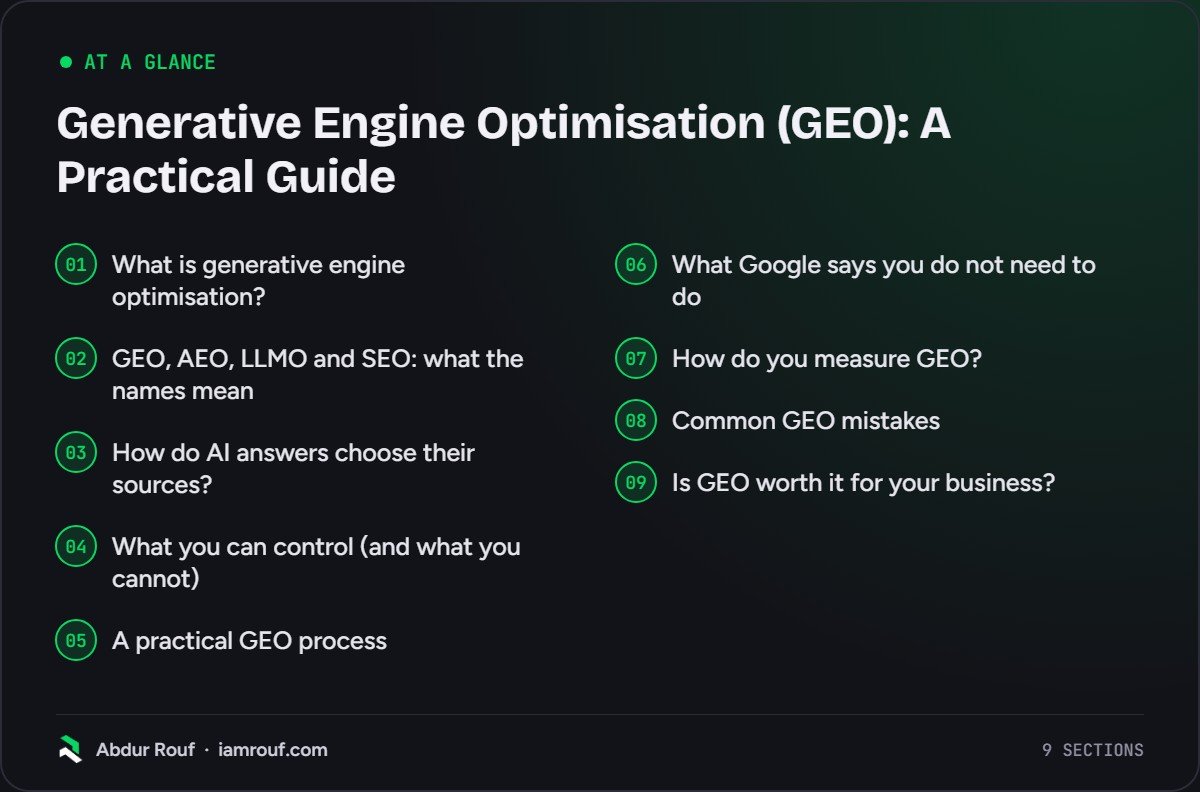
What is generative engine optimisation?
Generative engine optimisation is the practice of improving how often, and how accurately, your pages are used and cited in answers written by AI search tools. A “generative engine” is any system that retrieves web pages and then writes a summary answer from them, instead of only showing a list of links.
The term comes from a research paper on generative engines by Pranjal Aggarwal and co-authors, first submitted to arXiv in November 2023. They built a benchmark of queries, called GEO-bench, and tested ways of rewriting content. They report that their methods could boost visibility in generative engine responses by up to 40%, and that what worked varied by subject.
Treat that figure with care. It came from a research setting, not from live testing on Google or ChatGPT. The useful takeaway is narrower: the way content is written and supported can change whether an AI system uses it.
GEO, AEO, LLMO and SEO: what the names mean
You will see several labels for overlapping ideas. None of them is an official standard, and agencies use them loosely.
| Term | What people usually mean | Main focus |
|---|---|---|
| SEO (search engine optimisation) | Earning visibility in search results | Crawling, indexing, relevance, quality, links |
| GEO (generative engine optimisation) | Being used and cited in AI-written answers | Access for AI crawlers, clear facts, reputation |
| AEO (answer engine optimisation) | Giving direct answers to questions | Question-led headings, short answers, snippets |
| LLMO (large language model optimisation) | Influencing what chatbots say about a brand | Mentions, consistency, entity information |
Google’s position is blunt. Its guide to its generative AI features in Search says AEO and GEO describe optimising for the search experience, which is still SEO. It also warns site owners to judge third-party AEO and GEO advice carefully.
I agree with that for Google. For ChatGPT and Perplexity, the foundations are the same, but each platform has its own crawlers and rules, so there is a little extra work.
How do AI answers choose their sources?
Most AI search tools search first, then write. The system turns your question into one or more searches, retrieves pages from an index, picks the passages that answer the question, and writes a response that links to some of them. If your page is not in the index the tool uses, it cannot be cited.
Google’s guide names the two mechanisms behind this. Retrieval-augmented generation (which Google says is also known as grounding) means the model pulls pages from the Search index while it writes. Query fan-out is a set of related searches the model runs at the same time to gather more information. One question can therefore surface pages that rank for several narrower questions.
ChatGPT search follows a similar search-then-write pattern using OpenAI’s own crawler and third-party search providers. I go through OpenAI’s documentation in detail in how to rank in ChatGPT search.
In simple terms, a page goes through three stages before it is cited:
- Access: the platform’s search crawler is allowed to fetch the page, and your server or firewall does not block it.
- Retrieval: the page is indexed and is judged relevant to one of the searches the system runs.
- Selection: the model finds a passage that answers part of the question well enough to use and link.
There is a separate route: what a model learned during training. Answers written purely from training data often carry no citation at all. You influence that slowly, through what is published about you across the web, not through any single page.
What you can control (and what you cannot)
A lot of GEO advice blurs the line between things you control and things you hope for. Here is how I split it.
| Lever | You control it? | What it affects |
|---|---|---|
| Crawler access in robots.txt and your firewall | Yes | Whether a platform can use your pages at all |
| Indexing and snippet eligibility in Google | Mostly | Whether Google’s AI features can show your page |
| Content quality and originality | Yes | Whether your page is worth retrieving and quoting |
| Clear facts about your business | Yes | How accurately AI tools describe you |
| Mentions and reviews on other sites | Partly | Reputation signals and training data over time |
| Which passage is quoted, and the wording | No | How your information is summarised |
| Whether an AI answer appears at all | No | The platform decides per query |
The first row matters more than people think. OpenAI’s documentation on its crawlers says sites that opt out of OAI-SearchBot will not appear in ChatGPT search answers, though they can still appear as navigational links. It also says GPTBot (used for model training) and OAI-SearchBot are controlled separately in robots.txt. You can block training and still allow search.
For Google, the guide says a page must be indexed and eligible to show with a snippet to appear in its generative AI features. It adds that the site must be included in Search generative AI features in Search Console. Most sites only need to check that nobody has switched this off.
A practical GEO process
This is the order I would work in for a typical business site. Each step builds on the one before.
- Check crawler access. Read your robots.txt for rules that block Googlebot, Bingbot or OAI-SearchBot. Then ask your developer or host whether a firewall or bot-protection setting blocks them, because that will not show up in robots.txt.
- Confirm indexing. Make sure your key pages are indexed in Google and Bing. My technical SEO checklist covers the checks that matter here.
- List the questions you want to be cited for. Start from real customer questions, sales calls and your search data. My guide to keyword research works for this too: AI questions are usually longer, but the intent is the same.
- Make the page worth citing. Add something others do not have: first-hand experience, your own process, real specifications, clear prices or limits. Google’s guide calls this non-commodity content.
- Write so a passage can stand alone. Answer the question near the top of the section, use descriptive headings, and keep facts in text rather than images. My on-page SEO checklist covers headings, titles and structure.
- Keep business facts consistent. Your name, address, services and prices should match across your site, your Google Business Profile and directories. Google’s guide also says Business Profiles and product feeds in Google’s merchant tools help local businesses and shops appear in AI responses.
- Earn real mentions. Reviews, press coverage, industry lists and partner pages all describe you in other people’s words. Do this for its own sake, not as a trick.
- Measure, then repeat. Track the reports covered below and review your priority questions every month or so.
What Google says you do not need to do
Google’s guide includes a mythbusting section. It is worth reading in full, because it contradicts a lot of paid advice. In summary:
- llms.txt and other AI files: Google says you do not need new machine-readable files, AI text files, markup or Markdown to appear in Google Search, and that Google Search ignores them.
- Chunking content: there is no requirement to break content into tiny pieces. Google says its systems understand multiple topics on one page and there is no ideal page length.
- Rewriting for AI: you do not need to stuff pages with extra long-tail phrasings, because the systems understand synonyms and intent.
- Inauthentic mentions: Google says seeking inauthentic “mentions” across the web “isn’t as helpful as it might seem”.
- Special schema: structured data is not required for generative AI search and there is no special schema.org markup to add. It still helps with rich result eligibility.
Two cautions. First, this is Google speaking about Google. Other platforms have not all published equivalent statements. Second, “not required” does not mean “harmful”. Clear headings and accurate structured data are still good practice; they are just not a secret switch.
How do you measure GEO?
Measure GEO with the platform reports that exist, your analytics referral data and a simple, repeatable log of priority questions. There is no single “AI ranking” number. Answers can change between sessions and users, so look for trends over weeks rather than reacting to one result.
Here is what is available today:
- Google Search Console: Google’s guide points to a Generative AI performance report for seeing how your content performs in its generative AI features.
- ChatGPT referrals: OpenAI’s publishers and developers FAQ says ChatGPT adds
utm_source=chatgpt.comto referral links, so you can segment that traffic in your analytics tool. - A prompt log: pick 10 to 20 questions customers really ask. Run them on each platform you care about every few weeks, and note whether you are cited, which page, and what the answer says about you.
- Leads and enquiries: add “How did you hear about us?” to forms and calls. When someone answers “ChatGPT” or “Google’s AI”, that is often the clearest signal you will get.
Be careful with third-party tracking tools. Some are useful for spotting patterns across many prompts. Google’s guide warns against tools that promise ranking success or claim access to internal Google metrics, and I would apply the same scepticism to any tool’s “AI visibility score”.
Common GEO mistakes
Most of the problems I see come from chasing tactics before the basics are in place.
- Blocking the wrong bot. Blocking every AI crawler to stop training can also remove you from AI search results. Decide per crawler.
- A firewall nobody checked. Bot protection on your host or CDN can block AI search crawlers even when robots.txt allows them.
- Thin “AI-friendly” rewrites. Turning pages into short question-and-answer fragments rarely adds anything a model cannot find elsewhere.
- Mass-produced pages. Google’s guide says producing pages at scale to manipulate rankings counts as scaled content abuse under its spam policies.
- Buying mentions. Paid placements in “best of” lists may look like a shortcut. Google has said plainly that inauthentic mentions are not as helpful as they seem.
- Judging success by one prompt. AI answers vary. A single screenshot proves very little either way.
Is GEO worth it for your business?
For most businesses, yes, as part of good SEO rather than as a separate project. If your customers research before they buy, some of that research now happens inside AI answers. Being absent or described wrongly there is a real cost.
My opinion on priorities: a local trade business should put most effort into its Google Business Profile, reviews and a clear service site. A B2B firm or a specialist shop gains more from detailed, original pages and from being covered by credible sites in its industry. If your site has crawling or indexing problems, fix those first. No GEO tactic works on a page the platform cannot reach.
FAQs
Is GEO replacing SEO?
No. Google says its generative AI features rely on its core ranking and quality systems and that AEO and GEO are still SEO. ChatGPT and Perplexity also search an index before answering. GEO adds checks for AI crawlers and more focus on clear, citable facts, but the work underneath is the same: a crawlable site, useful content and a good reputation.
Does blocking GPTBot remove my site from ChatGPT?
Not according to OpenAI’s crawler documentation. GPTBot is the crawler for model training, and OAI-SearchBot is the crawler for ChatGPT search. They are controlled separately in robots.txt, so you can disallow GPTBot and still allow OAI-SearchBot. Blocking OAI-SearchBot is what keeps your pages out of ChatGPT search answers.
Do I need an llms.txt file for GEO?
Not for Google. Google’s guide says Google Search ignores llms.txt and similar AI files, and that they neither help nor harm your visibility there. Other platforms have not published clear statements either way. If a file is cheap to maintain you can add one, but I would not expect it to change your citations.
How long does generative engine optimisation take?
Nobody can give an honest timeline. Fixing access problems can show up quickly once crawlers revisit; OpenAI says robots.txt changes for search take about 24 hours to take effect. Content and reputation work takes longer and depends on your competition. Expect to review progress over months, not days.
Where to start with GEO
Start with access and indexing, then pick ten questions your customers ask and make sure your best page for each one deserves to be cited. If you would like an expert to check your crawler settings, content and AI visibility for you, see my AI search optimisation service.