 Abdur Rouf
SEO agency vs freelancer comes down to what your site needs and how much you want to manage. A freelancer usually costs less and gives you direct access to the person doing the work. An SEO agency costs more but brings a team, more capacity and cover when someone is away. Neither is better in every case.
A quick disclosure before going further. I do both: I run Eigme Digital, an SEO and AI search agency in Cardiff, and I also take freelance work through Upwork. So I have no reason to push you one way. I see the strengths and weak spots of each model from the inside.
This guide compares the two on cost, expertise, communication, capacity and risk, then explains when each tends to be the better fit and how to check either one before you sign.
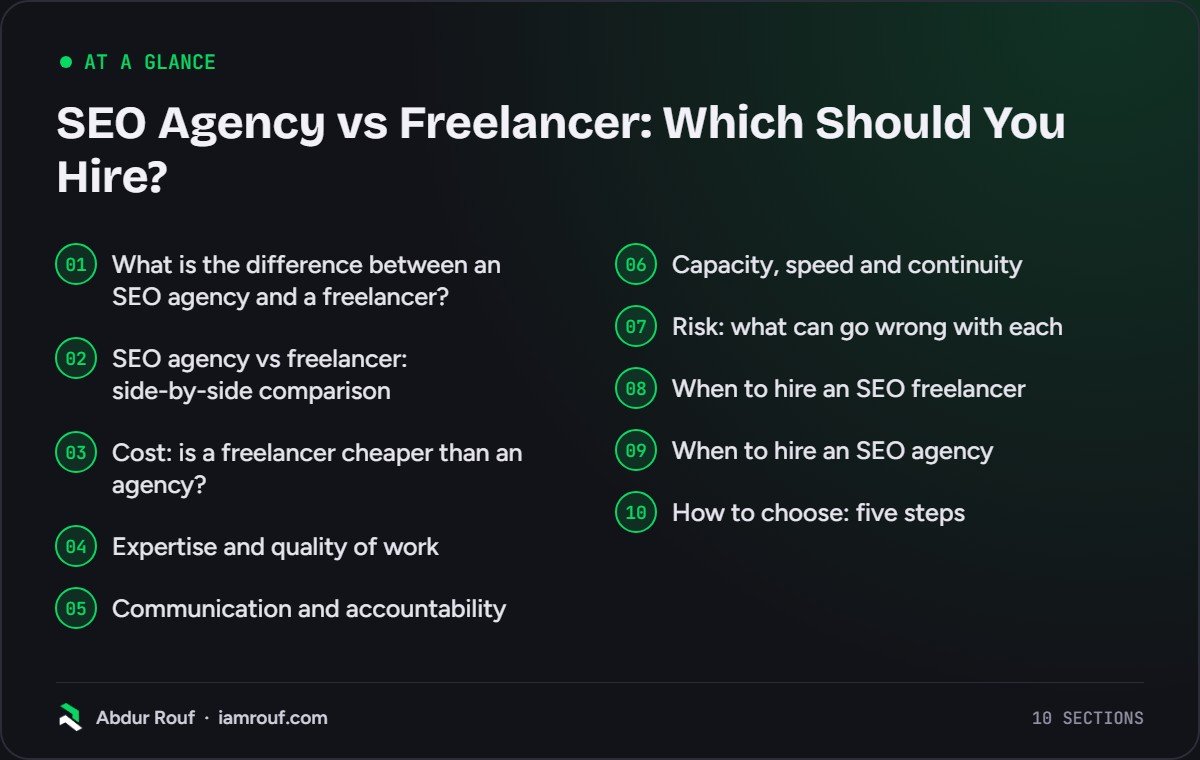
What is the difference between an SEO agency and a freelancer?
An SEO freelancer is one self-employed specialist who does the work personally, sometimes with a few trusted subcontractors. An SEO agency is a company with several people in different roles, such as strategists, technical specialists, writers and account managers, who share the work across clients. The real difference is team size, structure and who actually touches your site.
Those labels hide a lot of variety. Some freelancers have been doing SEO for well over a decade and run large projects. Some agencies are two people and a logo. Some small agencies also pass work to freelancers behind the scenes. So look at who will do the work, not just the label on the proposal.
SEO agency vs freelancer: side-by-side comparison
Here is how the two usually compare on the points that matter most when you hire. Treat it as typical, not universal.
| Factor | Freelancer | Agency |
|---|---|---|
| Cost | Usually lower, with fewer overheads | Usually higher, covering a team, management and overheads |
| Expertise | Deep in one person’s specialities, thinner outside them | Broader mix of skills across technical, content and links |
| Communication | Direct line to the person doing the work | Often through an account manager |
| Capacity | Limited by one person’s hours | Can add people for big projects or deadlines |
| Risk | Illness, holidays or a full diary can stall work | Staff turnover can mean a new person learning your account |
| Flexibility | Often easier to agree a custom scope or short engagement | More likely to sell set packages and minimum terms |
| Process | Depends heavily on the individual | Usually more structured, with defined reporting |
The sections below explain each point, because the details matter more than the ticks.
Cost: is a freelancer cheaper than an agency?
Usually, yes. In the Ahrefs SEO pricing study of 439 providers, freelancers’ average monthly retainer was around $1,349, against about $3,209 for agencies. Freelancers also charged less on average per hour and per project. Ahrefs based those averages on the top of each price band, so treat them as rough guides.
The lower price reflects lower overheads: no office, no account managers, no sales team. It does not automatically mean lower quality. But it does mean you are buying one person’s time, so check how many hours a month your fee actually buys.
With an agency, part of what you pay for is management, process and cover. That is worth having on a large or fast-moving account. On a small local site it can be overhead you do not need. For a full breakdown of pricing models and what drives cost, see how much SEO costs.
Expertise and quality of work
A good freelancer is often a senior specialist who does the work themselves. With an agency, the senior person may win the business while a more junior team member does much of the day-to-day work. Neither is wrong, but ask who will work on your site.
Agencies win on breadth. A site that needs technical fixes, a content programme, digital PR and local SEO at the same time may be too much for one person to cover well. A freelancer with gaps will either learn on your project or bring in subcontractors, which is fine if they tell you.
For a narrow job, such as a technical audit, a migration check or working through the items on a local SEO checklist, a specialist freelancer can be the stronger choice.
Communication and accountability
With a freelancer you talk to the person doing the work, so questions get answered quickly and nothing is lost in translation. With an agency, an account manager usually sits in the middle. That can slow things down, but it also gives you a named contact whose job is to keep the work on track.
Accountability works differently too. A freelancer’s reputation rests on every project, which is a strong motive to deliver. An agency has a business name, contracts and usually a complaints route. Either way, Google’s guidance on hiring an SEO suggests asking how they will communicate with you and whether they will share all the changes they make to your site, with the reasons.
Capacity, speed and continuity
This is where agencies have a clear edge. If a site migration has a fixed launch date, or you need 30 pages rewritten in a month, an agency can put several people on it. A freelancer has a hard ceiling on hours.
Continuity cuts both ways. If a freelancer falls ill or takes on too much, your project stalls. At an agency, people leave and accounts get handed over, and the new person has to learn your business. Ask both how they handle this: what documentation they keep, who covers absences, and what happens to your data if you part ways.
Risk: what can go wrong with each
The biggest risks are the same for both: poor-quality work, unsafe tactics and a lack of transparency. Google says unethical SEOs can break its spam policies, which can lower your site’s presence in Google or remove it from the index. A low-cost freelancer and a big agency can both do this.
Watch for these warning signs, whoever you hire:
- Guaranteed rankings or a promised number one position. Google states that no one can guarantee a number one ranking.
- Secrecy about what they will change or which links they will build.
- Asking for full admin access when read access would do the job.
- Reports that show activity but never connect to traffic, enquiries or sales.
- A long minimum contract with no clear exit or handover terms.
If a provider builds links you are not shown, read why black hat SEO is dangerous before you agree to anything.
When to hire an SEO freelancer
A freelancer tends to suit smaller, well-defined needs where direct contact and value for money matter most. Common situations:
- You run a small or local business with a modest budget.
- You need one specific job done well: an audit, keyword research, a technical fix or a content plan.
- You have an in-house developer or marketer and need expert direction rather than a full team.
- You want to work with one senior person and talk to them directly.
When to hire an SEO agency
An agency tends to suit larger sites, bigger budgets and work that needs several skills at once. Common situations:
- Your site is large, such as an online shop with thousands of products, or covers several countries.
- You need technical, content, digital PR and reporting delivered together.
- You have a hard deadline, such as a site migration or launch.
- You need formal contracts, insurance, procurement paperwork or cover for holidays and illness.
There are also middle routes. Some businesses use a freelance consultant for strategy alongside an in-house writer, or an agency for heavy lifting with a freelancer as an independent second opinion.
How to choose: five steps
- Define the job. Write down what you need done in the next three to six months. A clear brief often answers the agency vs freelancer question by itself. A simple SEO audit checklist helps you see what your site needs.
- Set a budget range. Decide what you can sustain for at least several months, not just the first one.
- Shortlist both types. Talk to at least one freelancer and one agency. Compare their questions as much as their answers.
- Ask Google’s questions. Google suggests asking for examples of past work, whether they follow Google Search Essentials, what results they expect and over what timeframe, and how they measure success.
- Check references and terms. Speak to past clients, and read the notice period, ownership and handover terms before you sign.
FAQs
Is it better to hire an SEO freelancer or an agency?
Neither is better in every case. A freelancer is often the better fit for small businesses, single projects and anyone who wants direct contact with a senior specialist. An agency is usually better for large sites, broad scopes and fixed deadlines that need more than one person. Base the choice on your brief, budget and the people who will do the work.
Are SEO freelancers reliable?
Many are very reliable, and some agencies use freelancers themselves. Reliability depends on the individual, so check their track record, references and reviews, and ask how they handle illness, holidays and busy periods. On platforms such as Upwork you can also read feedback from past clients before you hire anyone.
Do agencies outsource SEO work to freelancers?
Some do, especially smaller agencies and those offering white-label services. That is not a problem in itself, but you should know who is working on your site and how their work is checked. Ask directly whether any part of your project will be subcontracted, and to whom.
Can I switch from a freelancer to an agency later?
Yes, and it is common as a business grows. Make switching easy from day one: keep ownership of your Search Console, analytics and Google Business Profile accounts, ask for documentation of all changes, and agree handover terms in the contract. Then whoever comes next can pick up where the last person left off.
Talk through your options
The right choice is the one that matches your brief, your budget and how hands-on you want to be. If you would like an honest view on whether your site needs one specialist or a full team, get in touch through my SEO services.